
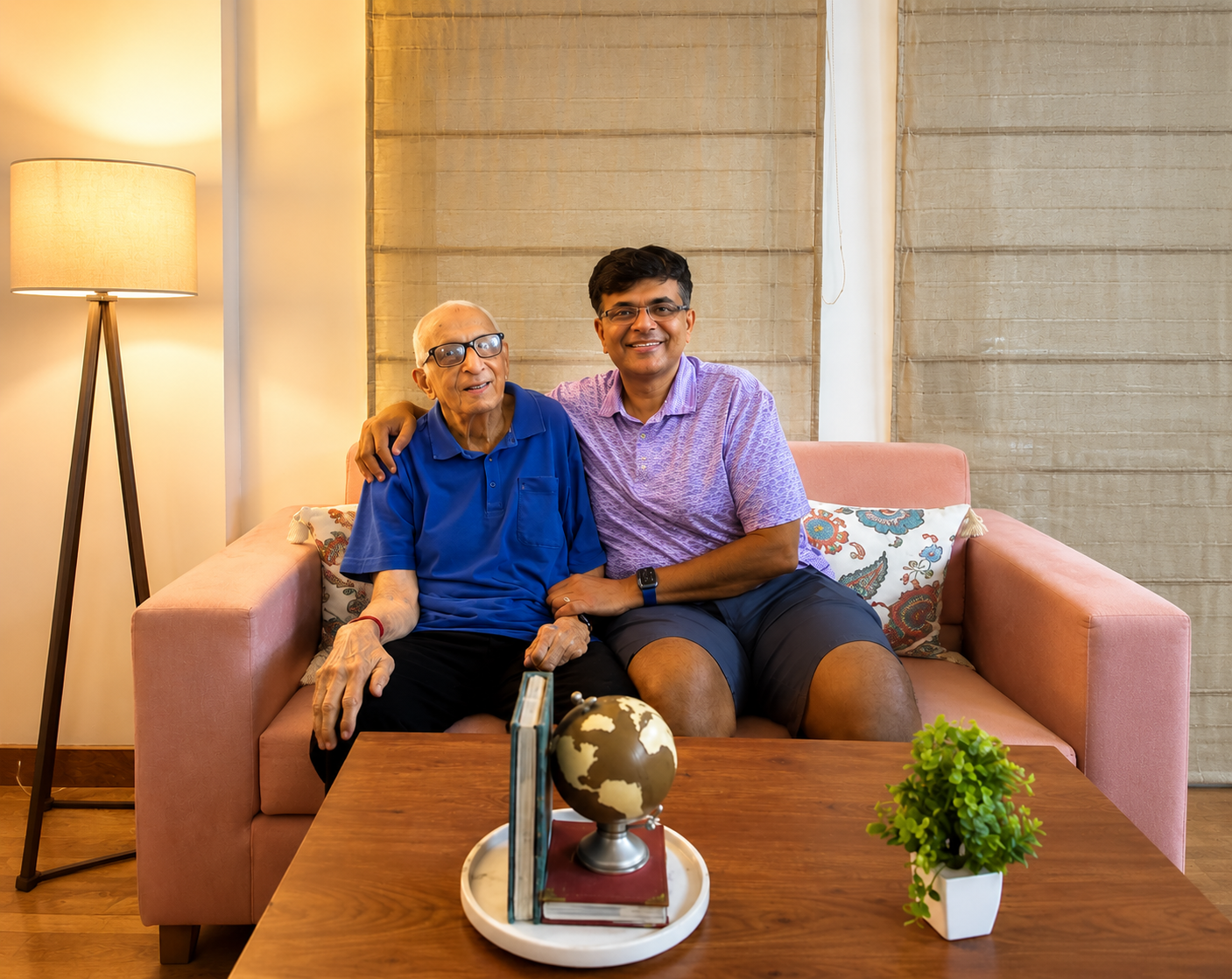
You notice it in small things first. The unopened strips of medicine on the kitchen counter. The way your father now takes the stairs one careful step at a time, both hands on the rail. A story repeated twice inside ten minutes. For most adult children in India, the search for living care for parents begins here, with a quiet worry rather than a plan.
The instinct at this point is to open a browser and start comparing facilities. That is the wrong first move. A better one is to answer a plain question before you look at a single brochure: what can your parent still do on their own, and where do they genuinely need a hand? Match that honest answer to the right level of support, and the decision stops feeling like a gamble.
This guide walks through the full range of care options for ageing parents in India, how to assess what your parent actually needs, the signs it may be time for more support, the real trade-offs of cost, safety, and social life, and how to bring your parent into the choice with their dignity intact.
What does living care for parents actually mean?
Living care for parents is not a single service. It is a continuum that runs from a few hours of help at home to round-the-clock support inside a residential community. Where your parent belongs on that spectrum depends on their health, their daily independence, and how much the family can realistically provide.
Think of it as a staircase rather than a switch. Most families climb one step at a time, adding support as needs grow, instead of jumping straight from full independence to a nursing bed. Naming the steps clearly is the first practical thing you can do.
The care continuum, from home care to nursing care
Broadly, senior living options in India fall into six levels. Each adds a layer of support and, usually, a layer of cost.
Care option | Best suited for | What it typically provides | Where you find it in India
Home care | Seniors mostly independent but needing some daily help | Attendants or nurses at home, by the hour or full shifts | The parent’s own home, via agencies or private attendants
Adult day care | Seniors alone by day while family works | Supervised activities, meals, basic health checks in daytime | Day centres in metros and larger towns
Independent living | Active seniors who want community and no chores | Private apartments, meals, housekeeping, security, social life | Senior living communities
Assisted living | Seniors needing help with daily activities (ADLs) | Personal care, medication reminders, staff on call 24×7 | Assisted living communities
Memory / dementia care | Seniors with Alzheimer’s or dementia | Secure setting, trained staff, structured routines | Specialised units within some communities
Nursing / skilled care | Seniors with serious or long-term medical needs | Clinical nursing, chronic disease management | Nursing homes and medical facilities
The lines between these levels blur in practice. A well-run community often combines independent and assisted living on one campus, so a Resident can move from one to the other without changing address or losing friends. That continuity matters more than most families expect.
How do you assess an ageing parent’s needs?
Start by measuring daily function, not diagnosis. Geriatric professionals use a checklist called Activities of Daily Living, or ADLs. The Katz Index of Independence in Activities of Daily Living, a standard used worldwide, ranks six basic tasks: bathing, dressing, toileting, transferring in and out of a bed or chair, continence, and feeding. A parent who manages all six scores full independence; help needed with two or fewer signals severe impairment.
Sit with that list honestly for your own parent. Then add what specialists call Instrumental Activities of Daily Living: the more complex work of running a life, such as cooking, managing medicines, handling money, using the phone, and getting around town. These often slip before the basic tasks do.
Nationally, the headline numbers look reassuring. India’s Longitudinal Ageing Study (LASI), which surveyed more than 31,000 people aged 60 and above, found only around 3% reported severe ADL disability. But an average hides the truth of a single home. Difficulty climbs steeply with age, and the population aged 80 and above is projected to grow by roughly 279% between 2022 and 2050, according to the UNFPA India Ageing Report 2023.
What are the signs it’s time for more support?
An honest ADL review usually surfaces the warning signs, but a few tend to appear first. Watch for:
– Medicines missed, doubled, or muddled
– Unexplained weight loss, or a fridge with little fresh food
– A fall, or a new fear of falling that keeps them indoors
– Unpaid bills and unopened post piling up
– Withdrawal from friends, hobbies, or phone calls
– Burns, scorched pans, or a gas hob left running
– A primary caregiver, often a spouse or one adult child, who is exhausted and unwell
One of these on its own is a conversation. Several together, or a single serious fall, is usually the point at which home-only care stops being safe. Waiting for a crisis to force the decision is the most common and most costly mistake families make.
Weighing cost, safety, and social life
Every option trades three things against each other: cost, safety, and social life.
On cost, home care can look cheaper on paper, and for light needs it often is. The maths changes once a parent needs supervision through the night. Two or three shifts of attendants, plus meals, medicines, and the hidden cost of a family member’s own time, can quietly overtake the monthly fee of a residential community that bundles all of it together. Prices vary widely by city, room, and level of care, so compare the full picture rather than the headline hourly rate.
On safety, a home retrofitted with grab bars still cannot match a purpose-built community with 24×7 staff, an emergency response plan, and medical help close at hand. For a parent with a history of falls or a heart condition, response time is not a luxury.
On social life, isolation is the risk families underestimate most. The UNFPA India Ageing Report 2023 found that more than 40% of India’s elderly sit in the poorest wealth quintile and about 18.7% live with no income of their own, and loneliness compounds every other strain. A good community’s real product is not the meals or the housekeeping. It is company, on tap, every single day.
How do communities like The Golden Estate fit in?
This is where a residential community earns its place. The Golden Estate, a premium senior living community at NIT Faridabad in Delhi NCR, has operated since March 2013, which makes 2026 its thirteenth year. It brings independent and assisted living together on one gated campus.
In practice, that means a parent can arrive independent, enjoy private furnished suites and studios, freshly prepared meals, housekeeping, a clubhouse, and daily recreation, and then step up to assisted living as tasks get harder, without leaving the friends they have made. The community provides 24×7 medical support, an in-house physiotherapist and psychologist, and round-the-clock security, which are some of the reasons families choose The Golden Estate (https://thegoldenestate.com/why-us/). It is a member of ASLI, the Association of Senior Living India, and an ambassador for the Commonwealth Association for the Ageing in India, both markers worth looking for in any community you shortlist.
One option deserves a special mention for anxious families: the trial stay. Before committing to anything long term, a parent can move in as a guest and taste the food, the people, and the daily rhythm for themselves. If your parent’s needs run to advanced dementia or intensive clinical nursing, ask the community directly whether it can meet them; independent and assisted living settings are designed for many needs, but not every one. You can compare its independent and assisted living stay options (https://thegoldenestate.com/our-stay-options/) and arrange a trial stay (https://thegoldenestate.com/trial-stay/) to see how the steps connect.
What questions should you ask when choosing care for parents?
Choosing care for parents comes down to the questions you are willing to ask on a visit. Take this shortlist with you:
– What is the staff-to-Resident ratio, both day and night?
– What exactly happens in a medical emergency, and how far is the nearest hospital?
– Which ADLs does the assisted-living tier support, and what triggers a move up a level?
– Can Residents with early dementia be cared for, and how?
– Who plans the meals, and can the kitchen handle diabetic or low-salt diets?
– Is a trial stay available before any long-term commitment?
– Is the community a member of ASLI or otherwise accredited?
– What does the monthly fee include, and what costs extra?
If the answers are vague or over-rehearsed, keep looking. A confident community answers plainly.
How do you bring your parents into the decision?
No plan works if it is done to a parent rather than with them. Raise the subject early, before a crisis removes the choice, and frame it as gaining support rather than losing independence. Many elders fear two things above all else: becoming a burden, and being abandoned. Naming those fears out loud takes away half their power.
Let your parent visit, share a meal, and meet Residents of their own age. A trial stay settles doubt in a way no brochure can. Give them genuine authority over the small decisions, the room, the routine, what to bring from home, and the larger decision starts to feel like theirs too. Dignity is not a feature you buy. It is how the whole conversation is conducted.
The one honest conversation that changes everything
If you take a single idea from this guide, let it be the order of operations. Assess your parent’s daily function first, match it to the right level on the care continuum, and only then compare communities. Do it before a fall forces your hand, not after.
The Golden Estate was built for exactly this moment: a place where independent and assisted living sit side by side and thirteen years of experience stand behind the care. Book a visit or a trial stay through the community’s contact page (https://thegoldenestate.com/contact/), bring your parent along, and let the place answer your questions in person.
Frequently Asked Questions
What is the difference between elderly care at home and assisted living?
Elderly care at home brings attendants or nurses to your parent’s own house for set hours, so surroundings stay familiar, but round-the-clock cover gets expensive and social contact is limited. Assisted living india moves your parent into a community where personal care, meals, and 24×7 staff are built in, adding company and safety alongside the support.
At what point should ageing parents move to assisted living?
Consider it when your parent needs help with two or more Activities of Daily Living, after a serious fall or health scare, or when the family caregiver can no longer cope safely. A pattern of missed medicines, weight loss, or growing isolation is a strong signal to plan the move rather than wait for a crisis.
What senior living options are available in India?
The main options are home care, adult day care, independent living, assisted living, memory or dementia care, and nursing or skilled care. Many communities, including The Golden Estate in Faridabad, combine independent and assisted living so Residents can change levels without relocating.
How much does assisted living cost in India?
Costs vary widely by city, room type, and level of care, so ask each community for an itemised monthly fee and a clear list of what it includes. Weigh that against the full cost of home care, including night attendants and a family member’s time, rather than the headline hourly rate.
Is it wrong to move my parent into a senior living community?
No. Choosing a well-run community with company, safety, and professional care is an act of love, not abandonment, especially once home has become isolating or unsafe. Involving your parent in the choice and starting with a trial stay keeps their dignity at the centre of the decision.
Ready to take the next step? The Golden Estate in NIT Faridabad welcomes families to visit, ask hard questions, and arrange a trial stay for an ageing parent. Reach out through the community’s contact page to begin the conversation.